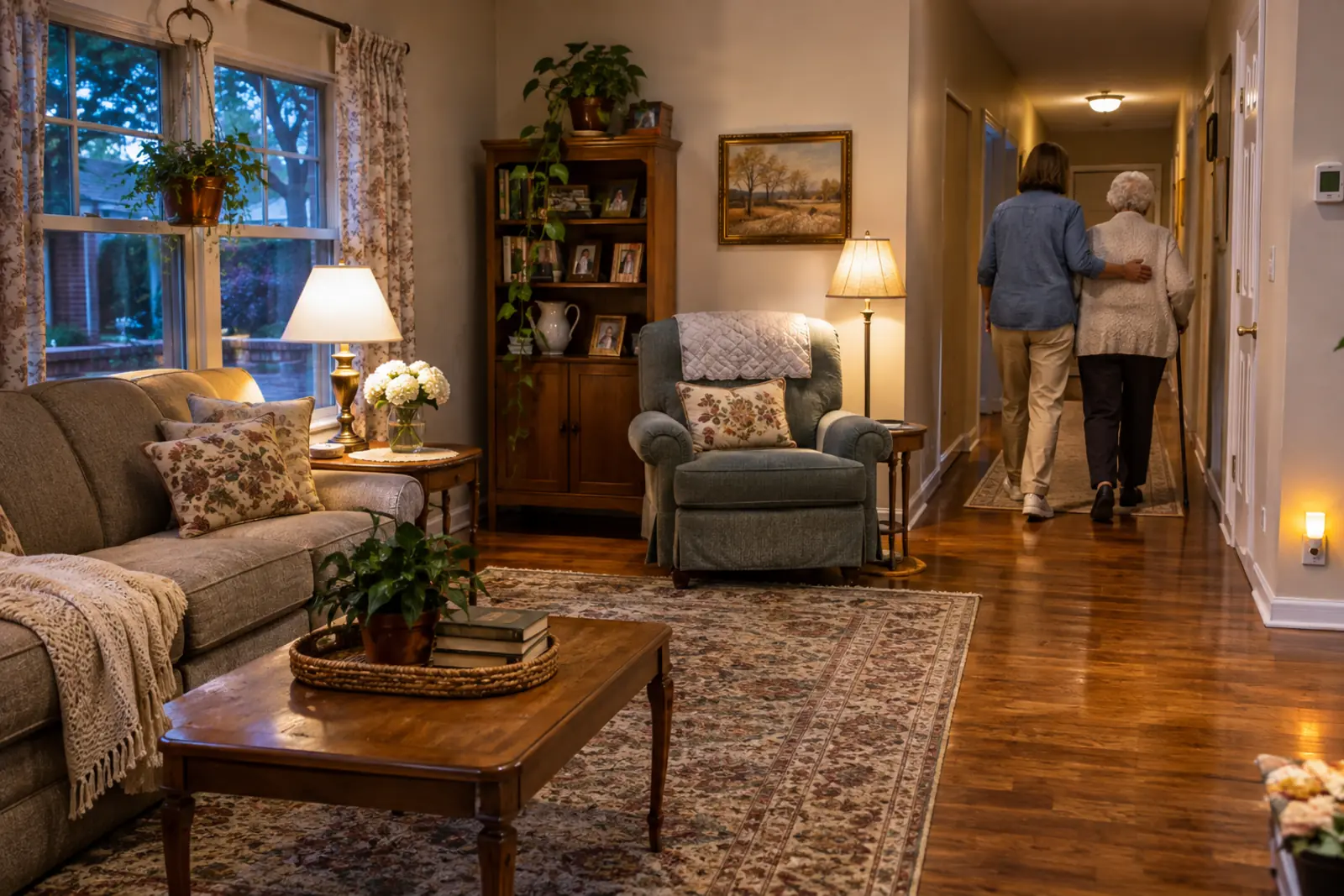
Dementia care at home means a family, often with paid aides, helps a person with memory loss live in their own or a relative's home instead of a facility. It works best with four things: early planning while the person can take part, a home made safer as abilities change, regular breaks for the main caregiver, and a plan for rising needs. The right arrangement depends on the person’s abilities, preferences, health, and available support. This page is general information and not medical, legal or financial advice; the person’s doctor decides about diagnosis and treatment, and the Georgia Department of Community Health determines Medicaid waiver requirements.
Plan while the person can participate
Begin with what matters to the person: familiar surroundings, privacy, daily habits, relationships, and preferred activities. Include the person in decisions as fully as possible. A diagnosis does not tell a family everything about someone’s ability to understand a particular choice.
Review legal and financial documents with a lawyer. Discuss who can make health and financial decisions, what authority existing documents provide, and what arrangements may be needed. Do not assume that being a spouse or adult child answers every question about decision-making authority.
Build a practical care outline alongside those documents. Record routines, medications, preferences, emergency contacts, and who handles meals, transportation, bills, and appointments. Identify backup help if the main caregiver becomes ill. Discuss how care could change before exhaustion or an urgent event forces a rushed decision. The guide to care plans and service agreements shows what a written plan from an agency usually covers.
Home safety for dementia: check as abilities change
Walk through the home together when possible. Look at how the person actually uses each room. Changes should support familiar activities while reducing hazards. Recheck arrangements when walking, judgment, vision, or sleep patterns change. The Alzheimer’s Association advises keeping the home from feeling too restrictive, so the person can stay as independent as is safe.
- Stairs: Clear steps and walking routes, check handrails, and consider whether essential activities could happen without stairs.
- Stove: Assess whether cooking remains safe without supervision. The Alzheimer’s Association suggests appliances with automatic shut-off and stove knob covers or removed knobs, while preserving participation in meal preparation.
- Medications: Establish who stores, organizes, and gives medicines. Keep medications in a locked drawer or cabinet when independent use becomes unsafe, and use a pill organizer or daily checklist.
- Firearms: The Alzheimer’s Association suggests considering removing firearms from the home or storing them in a locked cabinet.
- Locks: Review doors and windows while preserving emergency escape. Avoid arrangements that could trap someone inside, including locks on interior doors that the person could lock from the inside.
- Wandering: Plan supervision and a response if the person becomes lost (see the section below). Share relevant routines and concerns with everyone providing care.
- Lighting: Improve visibility along walking routes, especially between the bedroom and bathroom. Use night lights in hallways, bedrooms, and bathrooms, and notice confusing shadows or glare.
- Bathroom: Address slippery surfaces and difficult transfers. Grab bars at the shower, tub, and toilet and textured surfaces help; the Alzheimer’s Association also notes that hot and cold may be hard to tell apart, so check water temperature.
- Cleaning products and tools: Lock up laundry pacs, bleach, garage and workshop chemicals, and remove toxic plants or decorative fruit that could be mistaken for food.
Connect safety concerns with medical review
Home adjustments cannot explain a new symptom. Describe changes to the doctor, including when they began and what was happening around them. For immediate danger or a medical emergency, seek emergency help.
| Situation | Safety step | When to ask a doctor |
|---|---|---|
| Unsteady walking or falls | Clear routes and arrange help with difficult movement. | After a fall, with new unsteadiness, or when moving becomes painful. |
| Confusion about medicines | Have a designated caregiver oversee storage and use. | When doses may have been missed or repeated, or symptoms change. |
| Leaving home unexpectedly | Review supervision, exits, and the missing-person response plan. | When the behavior is new or accompanies other changes. |
| Difficulty with meals or drinks | Offer calm supervision and record the difficulty. | With swallowing concerns, reduced intake, or other new symptoms. |
Wandering: warning signs and what to do
The Alzheimer’s Association reports that six in 10 people living with dementia will wander at least once, and many do so repeatedly. Warning signs include returning late from walks or drives, trying to “go home” while already at home, pacing or restlessness, and trouble finding familiar places such as the bathroom.
- Schedule structured activity at the time of day wandering is most likely, often early evening, and make sure toileting, food, and water needs are met.
- Remove car keys if the person no longer drives, and use a door chime or monitoring device that signals when a door opens, and night lights.
- Keep a recent close-up photo and a list of places the person might go.
- If the person goes missing, start searching immediately and check nearby ponds, tree lines, fence lines, and brush. The Association says many people are found within 1.5 miles, and advises calling 911 if the person is not found within 15 minutes, telling responders that the person has dementia.
Make daily life easier to follow
A familiar sequence can make the day easier to understand. Keep meals, personal care, activity, and rest reasonably predictable, while allowing flexibility for fatigue or distress. Offer manageable tasks that match current abilities, such as folding towels or helping set the table.
Speak calmly, use short sentences, and allow time for a response. Offer simple choices instead of a long series of questions. Explain personal care before beginning, and protect privacy. If an interaction becomes upsetting, pause and consider discomfort, noise, hunger, fatigue, or an unfamiliar approach.
Changes in behavior deserve attention rather than blame. Keep brief notes about patterns for the care team. The National Institute on Aging’s Alzheimer’s and dementia information provides further reference material for families.
Arrange help before the caregiver is exhausted
Match help to actual tasks. A companion may provide company and support familiar activities; someone needing bathing, dressing, or toileting assistance needs help suited to those tasks. Ask about aides with dementia experience and how they respond when someone refuses assistance or becomes distressed. The comparison of home care, home health, and hospice in Georgia explains which type of provider does what.
Adult day programs may offer activity and time apart during the day. Respite provides a break from caregiving responsibilities. Explore the respite and caregiver support guide while there is time to assess options. A useful break requires dependable coverage and clear instructions, so the caregiver can rest or attend to other responsibilities.
Dementia care at home near me: where to start looking
Local options vary by county, so start with a few places that can see the whole picture. The Alzheimer’s Association runs a free 24/7 Helpline at 800-272-3900 (dial 711 for relay service) that can help with care planning, finding care providers, respite, and local programs; it does not give medical advice. The Area Agency on Aging for your county can explain assessment, services, and waiting lists. Before hiring an agency, check its Georgia license and read what Georgia requires for caregiver checks and training.
How Georgia programs may fit
According to DCH’s EDWP fact sheet updated in 2025, Alzheimer’s disease and dementia count as physical conditions when assessing functional impairment. CCSP and SOURCE are parts of EDWP, which supports community care as an alternative to nursing facility placement. A dementia diagnosis alone does not establish eligibility: assessed needs, nursing facility level of care, the care plan, and Medicaid financial requirements still matter.
DCH’s 2025 fact sheet includes personal support, adult day health, and respite among waiver services. Read the Georgia Medicaid waiver guide for context. Verify current requirements with DCH and ask the Area Agency on Aging about assessment, available services, and any waiting list.
Medicare home health addresses qualifying skilled nursing or therapy needs; personal care alone is not covered under its home health benefit, according to Medicare.gov’s coverage information. The Medicare home care explanation describes that distinction. Verify current coverage with Medicare.
Other sources may help pay for care: a long-term care policy may cover dementia care at home (see the guide to long-term care insurance in Georgia), veterans may qualify for extra benefits (see VA Aid and Attendance and home care in Georgia), and Georgia has a program in which a family member can be paid for caregiving, explained in structured family caregiving in Georgia.
Dementia care at home cost and how it compares with a nursing home
Costs depend on hours of care, not on a flat fee, so home care is cheaper for part-time help and can match or exceed a nursing home when round-the-clock paid care is needed. In its 2025 Cost of Care Survey (July to November 2025), CareScout reported national medians of $35 an hour for a non-medical caregiver, $9,581 a month for a semi-private nursing home room, and $10,798 for a private room. At 44 hours a week, the hourly rate comes to about $80,080 a year, according to CareScout. These are national figures, not Georgia prices; see home care costs in Georgia and Middle Georgia for local rates.
- Home care: You pay for the hours used and can add or cut them, but costs rise sharply with overnight or 24-hour supervision, and the family usually covers home changes, meals, and backup care.
- Nursing home: The monthly rate covers room, meals, and staff around the clock, but the person leaves familiar surroundings, and Medicare does not generally pay for long-term custodial care.
- What tips the choice: Safety at night, whether the person can be left alone at all, the caregiver’s health, and the ability to pay for the hours needed.
Ask about dementia experience and supervision
Georgia’s private home care staffing rule describes general training and competency requirements; these do not establish dementia expertise. Ask what additional preparation the agency provides. Verify current requirements with DCH because revisions have been proposed.
- What dementia-specific training do assigned aides receive?
- How are communication, personal care refusal, wandering, and changing needs handled?
- Who supervises care and responds when an aide reports a concern?
- How are preferences and successful approaches shared with substitute staff?
Review responsibilities, coverage gaps, charges, and service limits using the questions to ask a home care agency before you sign before making arrangements.
Recognize when home care needs reassessment
Reassessment is appropriate when the arrangement cannot reliably meet needs. Signs include:
- Repeated unsafe exits or serious household hazards.
- Transfers or personal care that caregivers cannot manage safely.
- Caregiver exhaustion, illness, or interrupted sleep that prevents dependable care.
- Needs exceeding available supervision, skills, or funding.
Discuss these changes with the doctor and care team. The next arrangement should reflect both the person’s needs and the caregiver’s capacity.
Sources for this page were last checked in November 2026.
Frequently Asked Questions
Can someone with dementia remain at home?
Often, with suitable support. Reassess the arrangement as abilities, supervision needs, and caregiver capacity change.
Is dementia care at home cheaper than a nursing home?
It depends on the hours needed. CareScout’s 2025 national medians were $35 an hour for a non-medical caregiver and $9,581 to $10,798 a month for a nursing home room, so part-time help costs far less, while around-the-clock paid care can cost as much or more.
Does dementia automatically qualify someone for a Georgia waiver?
No. DCH’s EDWP fact sheet updated in 2025 includes dementia as a physical condition, but functional, level-of-care, and financial requirements still apply.
What should I do if a person with dementia goes missing?
Search nearby right away and call 911 if the person is not found within 15 minutes, telling responders about the dementia, per the Alzheimer’s Association. Keep a recent photo ready.
Does general aide training establish dementia expertise?
No. Ask about dementia-specific preparation, supervised experience, and support when care becomes difficult.
When should a caregiver seek a break?
Plan regular relief before exhaustion develops. Additional help may be needed when caregiving affects sleep, health, or the ability to provide dependable care.